Most suppliers describe what they sell. We prefer to describe where they can join a project. A self-service terminal or a smart cabinet is a stack of layers, and a customer may already own several of them. The useful question is not "do you make terminals?" but "which layers do you want to hand over?"
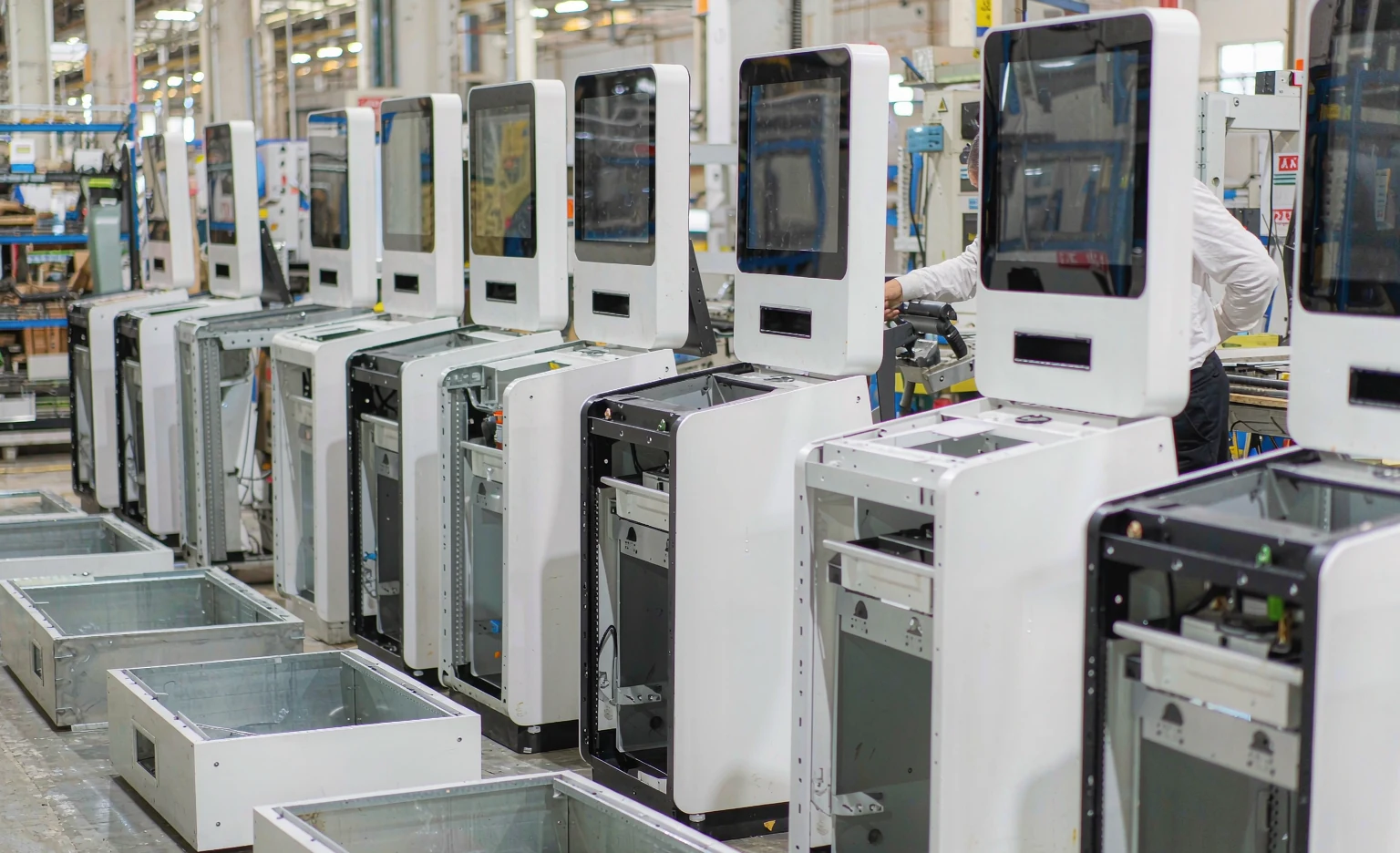
Below are the four levels we work at. They are not packages you must buy in full. They are handoff points you can choose from.
Level 1 · Cabinet body and enclosure
This is the mechanical platform: formed and welded steel, doors, panels, mounting plates, hinges, locks, gaskets, cutouts, finish and export packing. We review the drawing for manufacturability, build a first article, and produce the batch against the approved revision.
Customers choose this level when their engineering team owns the internal design and wants a repeatable enclosure from a factory that controls its own sheet-metal and coating route.
Level 2 · Enclosure with hardware integration
At this level we add the agreed hardware stack: display and touch mounting, card readers, scanners, printers, keypads, cameras, cooling, lighting, cable management, earthing and power distribution. A controlled BOM and an assembly sequence replace a simple parts list.
The boundary is written down. We state which components we supply, which the customer supplies, which interfaces are checked, and what is tested before packing. Hardware integration does not imply that we own your application or your brand.
Level 3 · Hardware with software loading
Some projects need the unit to arrive ready to run. We can load an approved operating image and customer application, set the agreed configuration, and run a defined boot or function test before shipment. The software remains yours. We treat it as a controlled build input, with the version and test procedure recorded in the production file.
This level is useful when your field teams install many identical units and repeating the setup on site costs more than doing it in the factory.
Level 4 · Platform interfaces and deployment support
At this level we can prepare the hardware for your connected platform: document the available data fields, mount and wire the selected gateway or communication module, provide the agreed hardware interfaces and support factory-side deployment checks. The monitoring platform, hosting, user accounts and operating data remain under your control.
The exact boundary is agreed project by project. It should identify the gateway, protocols, connector types, data points, test method and who owns the platform after shipment.
You do not have to buy the whole stack. Tell us which layers you want to keep, and we will build around them.
How projects actually use this
One customer sends a drawing and buys enclosures only. Another sends a reference unit and buys the complete hardware build. A third keeps the software and the cloud platform, and asks us to manufacture, load, test and ship the units. All three are normal projects for us.
The advantage of a fixed factory route is that the handoff is clean. Sheet metal, coating, assembly, testing and packing happen under one production plan, so a change at one level is visible at the next one instead of becoming someone else's problem.
What to send us to start
- The level you want to start with, and the level you want to hand over.
- Application, quantity and target market.
- A drawing, a reference photo or a written description.
- Which components, software or services you will supply.
- Testing, documentation and branding requirements.
We will confirm what we can own at each level and identify the information still needed before a quotation.