"IP65" appears on more cabinet drawings than almost any other specification. It is often written without a clear reason, and just as often without the details needed to achieve it. A short explanation of the code saves both time and money at the quotation stage.
Reading the code
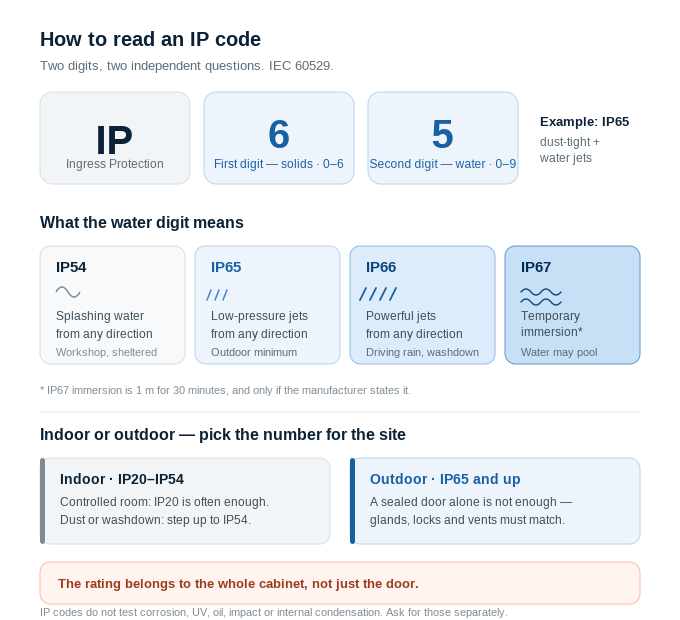
IP is defined by IEC 60529. The first digit covers solid objects and access to hazardous parts, on a scale from 0 to 6. The second covers water, on a scale from 0 to 9. Higher is more protection, but the two digits are independent: IP65 and IP54 are different answers to two different questions.
- IP54 — dust ingress in quantities that do not interfere with operation; splashing water from any direction.
- IP65 — dust-tight; low-pressure water jets from any direction.
- IP66 — dust-tight; powerful water jets from any direction.
- IP67 — dust-tight; temporary immersion, usually 1 m for 30 minutes, if the manufacturer states it.
An IP code does not test corrosion, UV resistance, oil, internal condensation or mechanical impact. Those need separate requirements.
Indoor service: less protection than you think
A cabinet in a controlled indoor space normally needs IP20 to IP54. IP20 protects against finger access and is common for indoor electrical panels. IP54 is a sensible step where dust, occasional splashing or washdown is expected, such as a workshop or a production area.
Specifying IP65 indoors is not wrong, but it adds gaskets, compression hardware and testing that the site may never use. It can also create a new problem: a sealed cabinet with internal heat-producing components needs a planned thermal path, or condensation will form inside.
Outdoor service: the number is one part of the answer
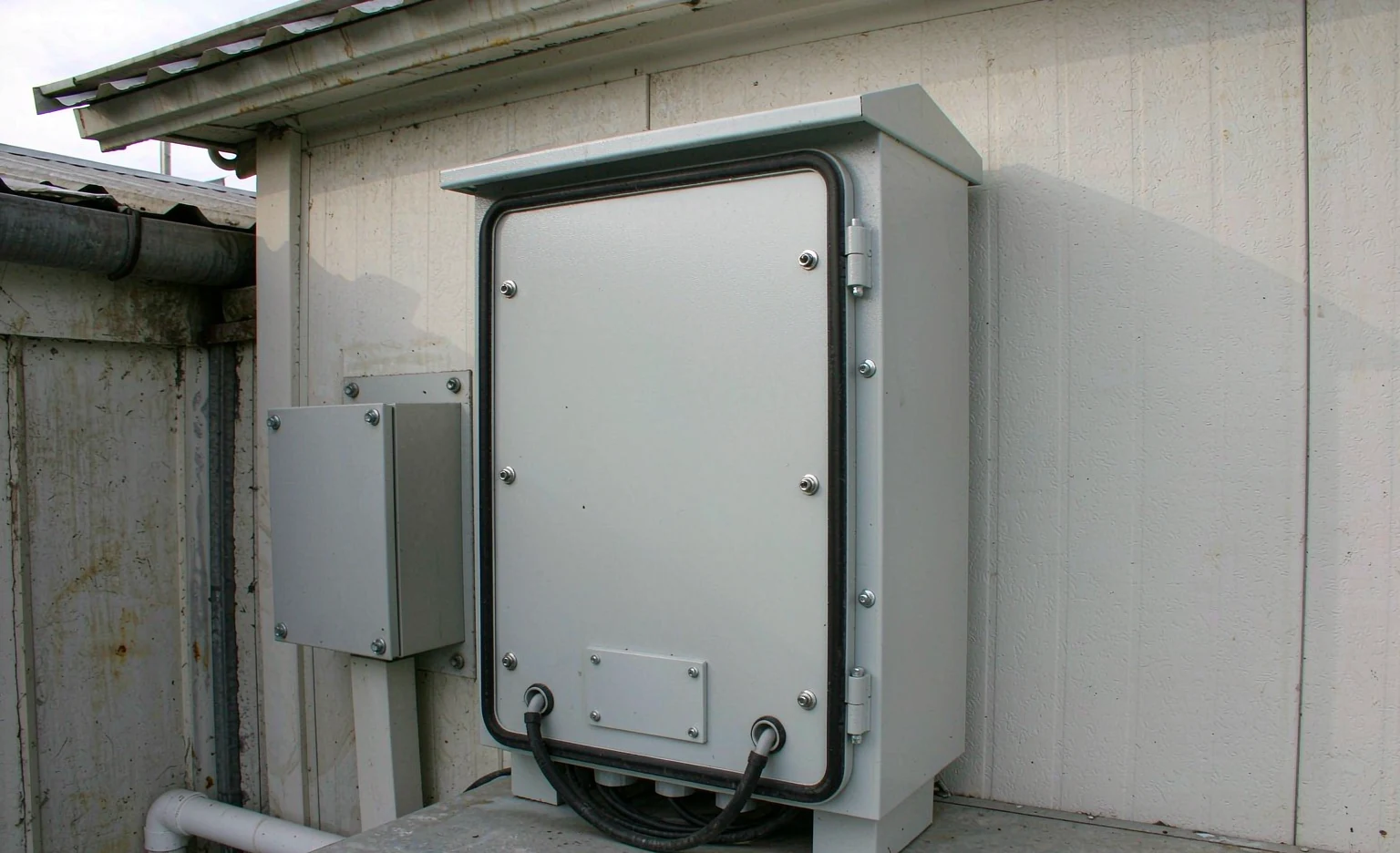
For an exposed outdoor cabinet, IP65 is a common minimum and IP66 is often specified where driving rain or hose cleaning is expected. But an IP66 door on a cabinet with unsealed cable glands is not an IP66 cabinet. The rating belongs to the complete assembly.
What has to be specified together
- Door gasket material and compression.
- Rated cable glands and sealed unused openings.
- Sealed locks, hinges or fixing covers.
- Ventilation that protects without letting water in.
- Drainage where water can collect on a horizontal surface.
- Material and coating for corrosion and UV exposure.
- Internal condensation control where temperature swings are large.
Specify the environment first and the IP number second. The number should describe the site, not the certificate.
Why regions ask for different things
Most of Europe, Asia and the Middle East specify IP codes under IEC 60529. North American projects usually specify NEMA enclosure types under NEMA 250. These systems are not interchangeable.
IP codes measure ingress only. NEMA types also test conditions such as corrosion, external icing, oil and coolants. For example, a NEMA 4X enclosure is expected to resist corrosion through salt-spray testing; an IP66 enclosure has no equivalent corrosion requirement. This is why a supplier cannot honestly promise that "IP66 equals NEMA 4X" without a separate corrosion specification.
The conversion also runs in one direction only. A NEMA-rated enclosure can be shown to meet or exceed a certain IP level, but an IP-rated enclosure cannot be converted into a NEMA type without the additional tests. If a North American buyer asks for NEMA 4X documentation, an IP test report alone will not satisfy the inspector.
Climate zones change the practical requirement
Even within the IP system, the same number suits different climates for different reasons. A coastal site cares about salt air and corrosion more than a dusty inland site. A hot, humid region cares about condensation when a cabinet cools overnight. A cold region cares about external icing at the door seal. A desert site cares about fine dust and UV damage to gaskets.
Two projects can both specify IP65 and still need different door gaskets, coatings, gland materials and internal heaters. For an export project, send the destination and the installation condition together with the IP number.
A short specification checklist
- Indoor or outdoor, sheltered or exposed.
- Required IP code, or NEMA type for North America.
- Coastal, chemical, dusty or icing conditions.
- Cable entry count and gland rating.
- Corrosion and UV requirements for material and coating.
- Condensation or heating provision.
- Test method and records expected before shipment.
We can review an IP or NEMA requirement against the intended site and tell you where the drawn specification is incomplete. It is easier to adjust a line on a drawing than to rebuild a batch after delivery.