Most damage claims begin before the container is loaded. The right packing method depends on two things: the state in which the cabinet leaves the factory, and the number of handling points between our door and your site.
1. The first decision: flat-pack or fully assembled
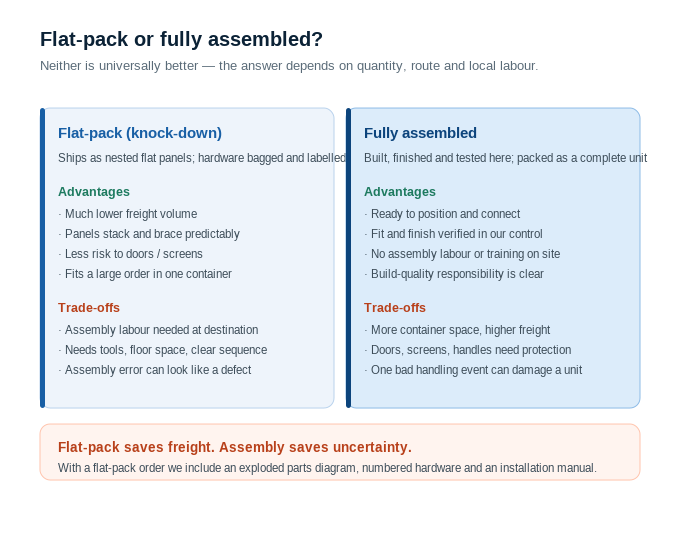
This choice affects cost, damage risk and the work waiting at the customer's site. Neither is universally better — the right answer depends on quantity, route and local labour.
Flat-pack (knock-down)
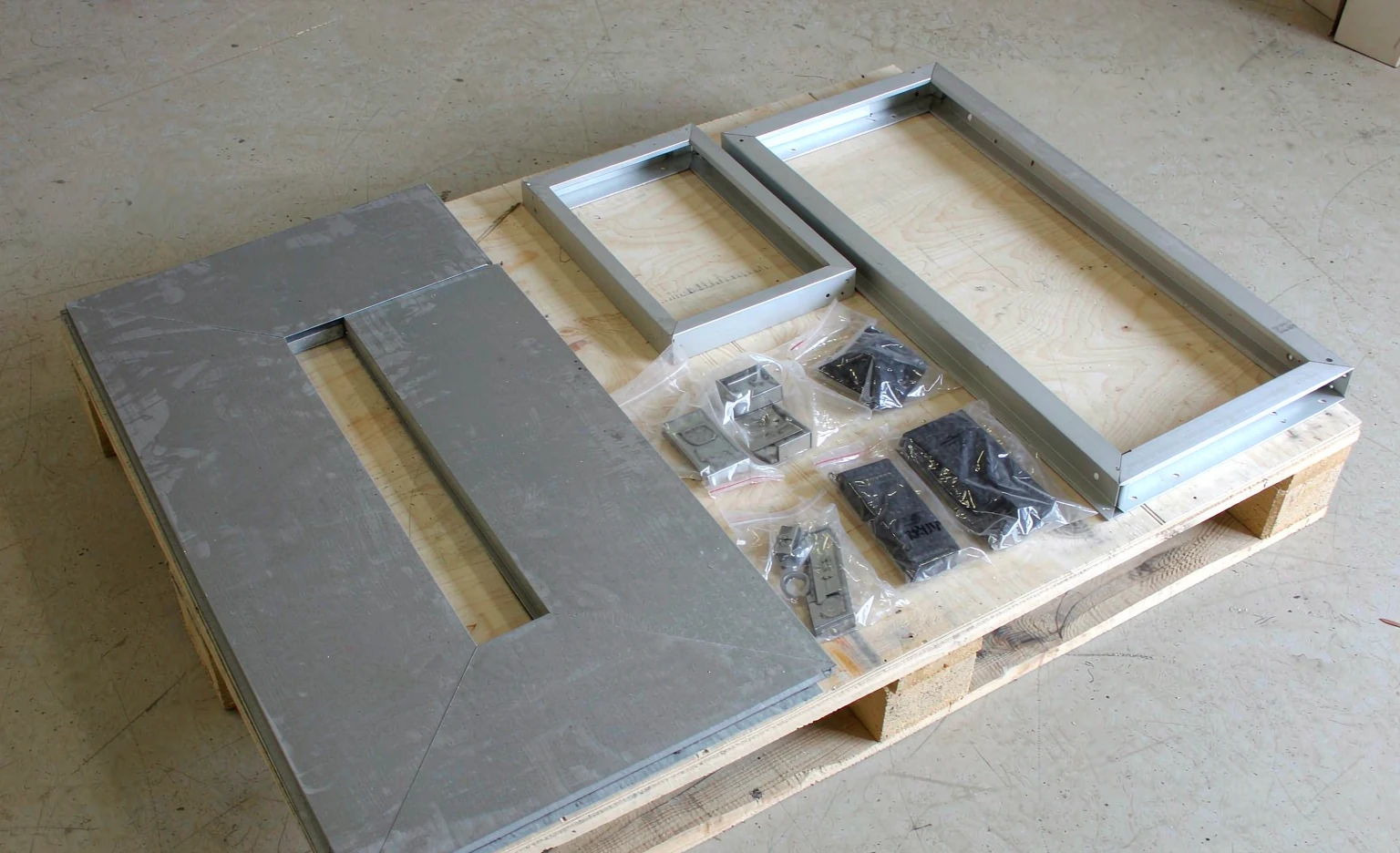
The cabinet is shipped as flat panels — sides, top, base, doors — with hardware bagged and labelled separately. Panels nest together, so a container carries far more units.
- Advantages: much lower freight volume; no bulky assembled frames to pad; flat panels stack and brace predictably; less risk of a door or screen being damaged in transit; often the only way to fit a large order into one container.
- Trade-offs: somebody has to assemble it at the destination. That needs labour, basic tools, floor space and a clear understanding of the sequence. An error in assembly can look like a manufacturing defect. Warranty questions are harder when the last steps happened away from our factory.
Fully assembled
The cabinet is built, finished and tested here, then packed as a complete unit.
- Advantages: arrives ready to position and connect; fit and finish are verified under our control; no assembly labour or training needed at the destination; responsibility for build quality is unambiguous.
- Trade-offs: takes far more container space, so freight per unit rises; protruding doors, screens and handles need careful protection; a single bad handling event can damage a finished unit.
2. What we supply with a flat-pack order
A flat-pack is only as good as the instructions that come with it. Every knock-down shipment includes an installation manual covering:
- An exploded parts diagram with a numbered item list.
- Step-by-step assembly sequence with the recommended number of people.
- Hardware kits bagged and labelled to match the diagram.
- Tools required (normally standard hand tools — we state clearly if anything special is needed).
- Torque and alignment points that affect door gaps and gasket compression.
- A final checklist so the installer can confirm the unit is square, level and correctly sealed before commissioning.
If the site team has not assembled one of our units before, we can review the first assembly by video. The manual is written for the specific model, not a generic cabinet — a detail that matters when gaskets, hinges or anchoring differ between designs.
3. Choosing between the two
Ask these before the quotation is fixed:
- What does assembly labour cost at the destination, and is it reliable?
- How many units are shipping, and does freight volume dominate the landed cost?
- Is there a trained installer on site, or will the customer assemble it themselves?
- Does the design include fragile items — glass, screens, calibrated components — that are safer shipped separately?
- Who signs off the installation, and how will a problem be classified as assembly vs manufacturing?
A common pattern: small quantities and distant sites go fully assembled; large container-load orders with local installation teams go flat-pack. Mixed projects are possible — the same model can ship assembled in one crate and flat-packed in another if the route demands it.
Flat-pack saves freight. Assembly saves uncertainty. The right answer is the one that matches the team at the receiving end.
4. The outer package: carton, pallet or crate
Once the shipping state is decided, the outer package follows:
- Carton — light units and internal components. Cheap and compact, but offers little protection against crushing or moisture on a long route.
- Pallet with stretch wrap — medium-weight cabinets, short handling chains. Good for loading and fork handling, weaker against impact and stacking.
- Wooden export crate — heavy or fragile units, long sea routes, multiple transhipments. Highest cost per unit, lowest damage rate.
For a fully assembled cabinet, a crate is not just a box around it. The unit must be fixed so it cannot shift, tilt or carry the weight of the stack above: a load-bearing base, side bracing, and separation between the cabinet surface and the timber.
5. Moisture protection is a system
Protective film on the cabinet, desiccant inside the package, a humidity indicator card at a visible point, and a sealed outer barrier. A desiccant sachet thrown into an unsealed carton does nothing — it saturates before the container is loaded.
6. Marking that survives handling
Carton marks must match the packing list: model, quantity, gross weight, destination and handling symbols. Mark both sides of a crate. A crate that is turned during unloading should still be readable. On a flat-pack order, each carton should also state which assembly stage its contents belong to — this turns a pile of panels into a sequence.
7. Questions worth asking before the quote is fixed
- Flat-pack or assembled — and who assembles at the destination?
- How many times will the goods be handled between us and your site?
- Is the route sea, air, rail or road — and how long is the storage in between?
- Does the destination require treated timber or fumigation documentation?
- Are the units stacked, and if so to what height?
- Who opens the package at the receiving end, and with what tools?
8. How this connects to receiving
The packing method and the carton mark are the basis of the receiving check. On an assembled unit, the buyer photographs the crate before opening. On a flat-pack order, they also check that every labelled carton is present before assembly starts — a missing hardware bag is easier to resolve before the panels are upright. Packing, shipping and receiving are one process seen from three ends.
Tell us the quantity, the destination and who will install the units. We will recommend flat-pack or assembled, and show exactly what is included in the packing.